Ros2 Filtered Imu Without Host Fusion Uk
Direct answer: a ROS 2 team should consider a filtered IMU when the robot needs orientation data quickly and the host computer is better used for navigation, perception and logging. The caveat is simple: ROS support on a product page is not the same as a tested package for your exact distro.
What onboard filtering changes
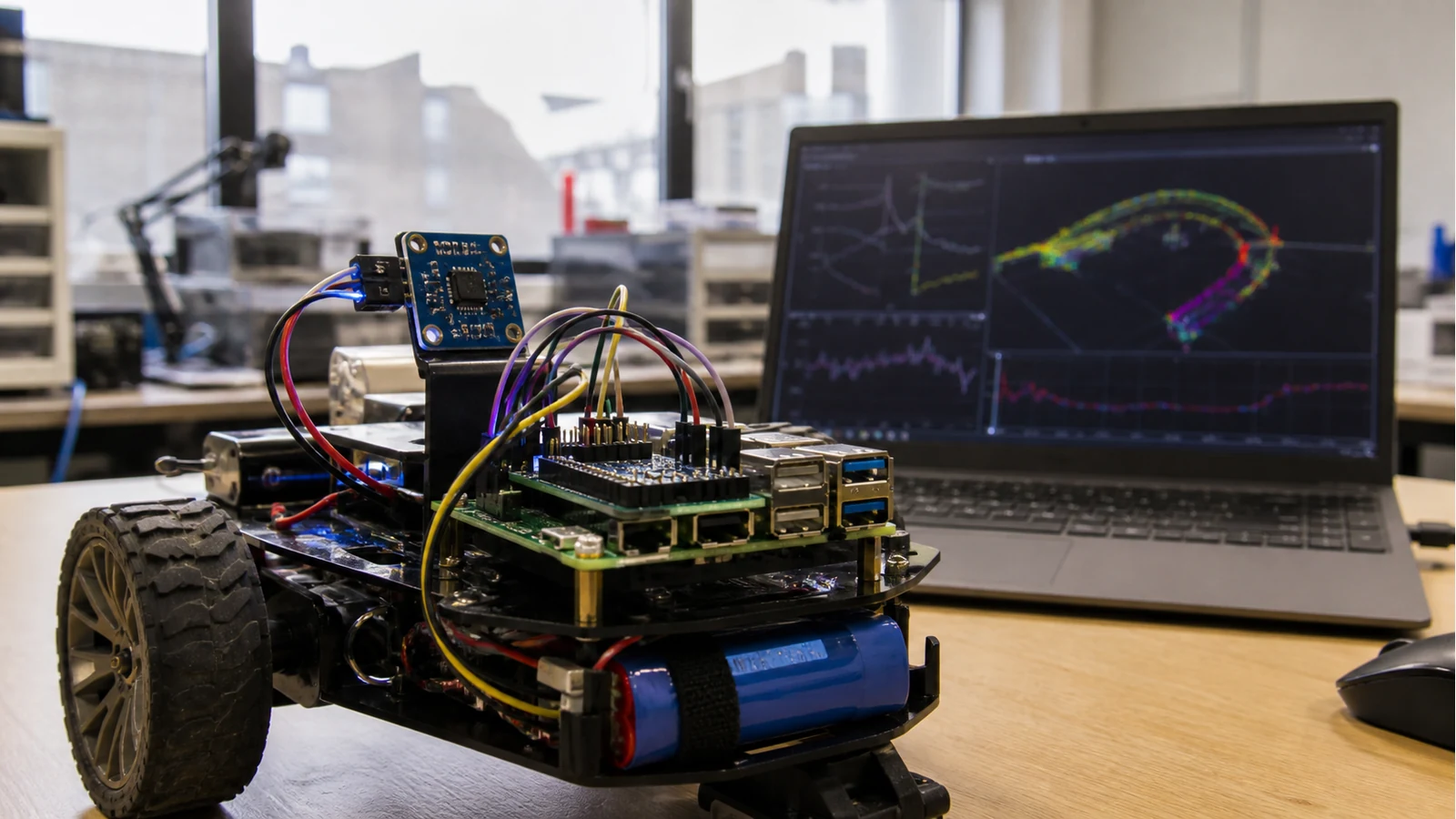
With host fusion, your Raspberry Pi or small x86 box receives raw accelerometer, gyroscope and magnetometer data, then estimates attitude in software. With a filtered IMU, the module outputs attitude estimates directly, so your ROS work becomes parsing, frame naming, timestamping and publishing. That is still engineering work, but it is narrower.
Integration checklist
- Confirm the physical interface: Bluetooth, UART or USB.
- Confirm output fields: Euler, quaternion, angular velocity and linear acceleration are not interchangeable.
- Define frames before coding: sensor frame, base_link and mounting rotation.
- Check timestamp ownership: sensor time, host receive time or bridge node time.
- Test at low rate first, then raise the output rate once parsing is stable.
- Log bag files before connecting the value to navigation decisions.
Version caveat
The UK market has ROS-labelled IMUs, but availability and exact stack support vary. The Pi Hut ROS IMU feature listing describes ROS1/ROS2 support while also marking the listed item discontinued. The manufacturer page for a comparator, Waveshare 10-DOF ROS IMU product page, is useful for checking interface and feature claims, but your team still needs to test its own ROS 2 distribution.
When this route is a good fit
It fits a rover, AGV or arm prototype where the sensor is an enabling component, not the research topic. It is less suitable if your product differentiates on fusion quality or if you need auditable algorithm internals.
If the condition is "we need filtered angle output and can validate the driver ourselves", a same-site option such as WT901BLE5.0 is worth checking. Do not buy solely because a page says ROS; buy when the interface, examples and fallback logging path are acceptable.
FAQ
Can I skip calibration?
No. Onboard filtering still depends on calibration and mounting discipline.
Should I publish Euler angles or quaternions?
Most ROS pipelines prefer quaternions for orientation messages, but Euler angles can help with human debugging.